Practical Applications for Pedestrian Safety Systems
Pedestrian Safety at Airports
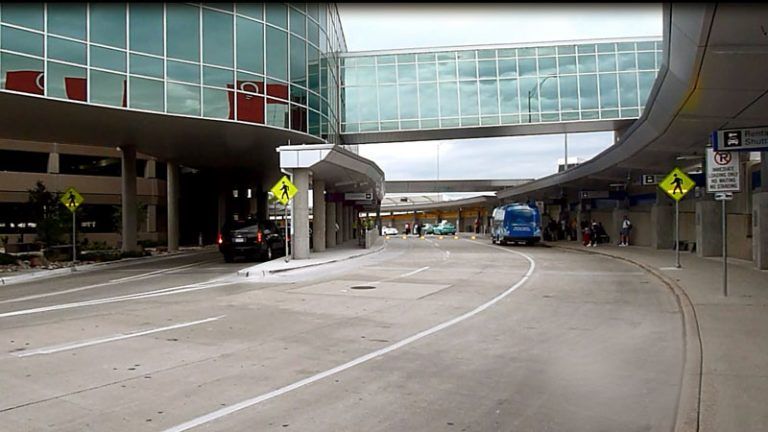
Landside airport crosswalks are among the busiest pedestrian crossings globally, making pedestrian safety at airports a public traffic safety concern. With passive pedestrian-activated bollards, in-roadway warning lights, and flashing LED signs - the hurried and distracted traveling public is given a safer crossing environment.
Approaching motorists are equally distracted as they scan terminal sidewalks for their arriving travelers. Smart Crosswalk™ alerts them of pedestrian activity up to 1,000 feet before the crosswalk, allowing drivers ample time to slow to a stop.
Dallas Love Field, TX, Project Summary
Client: Dallas Love Field Airport, TX
Project Size: 25 In-Roadway Warning Lights, 12 Bollards, 3 LED Border-Enhanced Pedestrian Signs
Year Installed: 2012
Overview: Dallas Love Field needed enhanced safety for their travelers with increased pedestrian visibility and advanced warning to motorists.
Requirements: A robust, flexible traffic safety solution that is effective at warning motorists up to 1,000 feet in advance of pedestrians in a crosswalk.
“Since we installed the LightGuard Systems in-roadway warning lights and LED signs at pedestrian crossings, we’ve really seen an increase in motorist yielding and a positive effect in the overall safety of our travelers.”
—Jimmy Jackson, Electrical Supervisor, Dallas Love Field Airport
LightGuard Systems Airport Installations Include:
ARIZONA
Phoenix Sky Harbor International Airport, Phoenix
CALIFORNIA
Charles M. Schulz Sonoma County Airport, Santa Rosa
John Wayne Orange County Airport, Santa Ana
McClellan Palomar Airport, Carlsbad
San Francisco International Airport, San Francisco
FLORIDA
Jacksonville International Airport, Jacksonville
Miami International Airport, Miami
Orlando Sanford International Airport, Sanford
Palm Beach International Airport, West Palm Beach
HAWAII
Honolulu International Airport, Honolulu
MASSACHUSETTS
Logan International Airport, Boston
OKLAHOMA
Tulsa International Airport, Tulsa
Will Rogers Airport, Oklahoma City
PENNSYLVANIA
Pittsburgh International Airport, Pittsburgh
RHODE ISLAND
T.F. Green International Airport, Warwick
TENNESSEE
Nashville International Airport, Nashville
TEXAS
Dallas-Fort Worth International Airport, Dallas
Dallas Love Field Airport, Dallas
El Paso International Airport, El Paso
San Antonio International Airport, San Antonio
William P. Hobby Airport, Houston
WASHINGTON
Spokane International Airport, Spokane
Citywide Pedestrian Safety
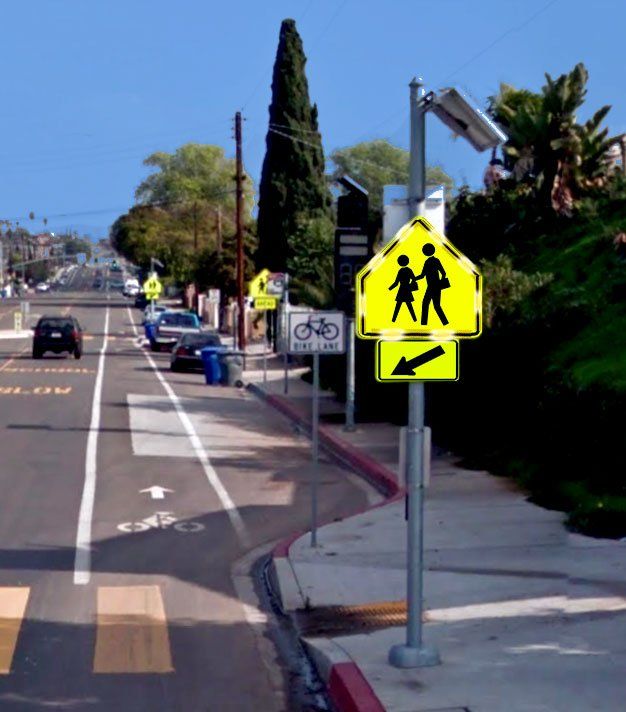
Implement LightGuard Systems’ traffic calming solutions at a single crosswalk location or install them throughout communities and neighborhoods as part of a Citywide pedestrian safety enhancement project.
National City, CA, Citywide Project Summary
Type: Citywide mid-block pedestrian, bike, and school zone safety crossing enhancement
Preferred Architects: Dokken Engineering
Preferred Installing Contractor: Perry Electric
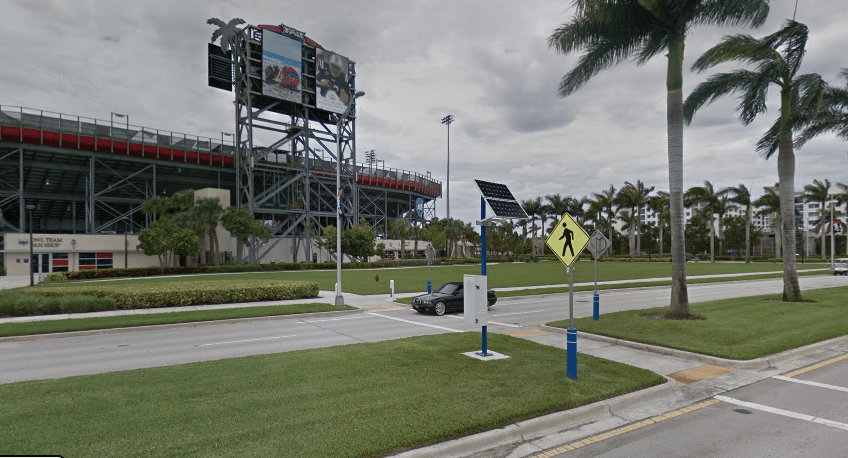
College and university campuses have a considerable volume of pedestrian traffic—often more than in other public settings. They feature mixed-use spaces with dorms, cafeterias, retailers, and restaurants accessible via multiple channels—trails, sidewalks, and roadways. This creates a more significant potential for conflicts between motorists and pedestrians.
On most campuses, hotspots exist where pedestrian incidents occur. Facility managers use LightGuard’s robust flashing LED lighted crosswalk systems to enhance pedestrian safety at college and university campuses.
Florida Atlantic University Project Summary
Studies & Reports
To date, there have been numerous studies determining the effectiveness of in-roadway warning lights (IRWLs) in a variety of settings and roadway safety applications.
Whether the study compares the effectiveness of overhead signals to IRWL, identifies ideal IRWL placement, or the efficacy of uni-directional IRWL systems, every IRWL study conducted leads to the same conclusion. The incidence of conflict between pedestrians and motorists decreases, and motorists yielding to pedestrians and stop time significantly increases.
Below are industry studies using LightGuard Systems' flashing in-roadway warning lights to illuminate pedestrian crosswalks, rail grade crossing vehicle stop lines, and to flash in sync with stop light signals at a controlled intersection.
Written Specifications
Bid specifications are critical to determining the exact nature of the crosswalk systems desired for a particular location. These are generic specifications written to provide easy-to-follow guidelines when developing bid package specifications.
The sections included are:
- Logic Control Device and Enclosure
- Solar Powered Logic Control Device and Enclosure
- In-Pavement Signal Heads
- LED Enhanced Pedestrian Crossing Symbol Signs
- Bollards
- Push-buttons
Product Warranties
LightGuard Systems (LGS) Product Warranty Policy for Products and Components
Subject to the Conditions and Exclusions noted below, LGS warrants to the end-user that each LGS product, when registered, installed, and operated under regular use and maintained according to the instructions furnished with the product, will be free from defects in materials and workmanship. LGS agrees that it will, at its option, either repair any such defect or replace the non-conforming product or part thereof with an equivalent replacement product or part at no charge to Buyer/end-user for LGS-branded or LGS-supplied parts for the periods set forth below:
1 Year Limited Warranty – Third party manufacturers’ non-value added product such as batteries, enclosures, solar panels, push buttons, static signs, etc., for a period of 1 year from date of installation. Warranty period will never start later than 6 months after the date of purchase from LGS. If a third party manufacturers’ standard warranty period is greater, their warranty period will apply. In some cases, Buyer/end user may need to facilitate the warranty coverage directly with a third party manufacturer, rather than LGS.
3 Year Limited Warranty – In-Roadway Warning Lights (IRWL), Bollards, Controllers, and related cabling, Rectangular Rapid Flashing Beacons (RRFB), LED Signs, and base plates for a period of 3 years from the date of purchase.
An IRWL is considered failed when 1/3 or more of its LEDs are inoperable. When an IRWL fails, the manufacturer covers replacement at no cost to the end user, subject to the return of the failed IRWL to the manufacturer.
For Limited Warranty coverage outside the USA, contact your local LGS representative, as coverage may vary.
Conditions & Exclusions of Warranties
All products must have been purchased from LGS or an authorized LGS Dealer. All LGS products are designed to function/operate as an integrated system. LGS does not warranty any of its products to function or provide any level of safety when directly integrated with other non-LGS products/brands.
This Limited Warranty does not cover any product that has been subjected to damage/abuse, misuse, alteration, neglect, unauthorized repair or installation, connection to an improper power source, operation beyond its manufactured specifications and limits, improper site preparation, maintenance not in accordance with manufacturer instructions, or operation with components not supplied or approved in writing by LGS, including, but not limited to, buttons, switches, system wiring, and cabling. Refer to the LGS manufacturer installation instructions.
This Limited Warranty is void if the product has been subjected to adverse conditions, or otherwise operated outside its specified environment; or if the FIELD RELATED TOTAL PREVENTATIVE MAINTENANCE (Section 8.3) of the LGS Installation Manual has been neglected.
This Limited Warranty does not cover the finish or non-functional appearance of any product. Buyer, if different than end user, shall be solely liable to the end-user for the condition of the products as installed. Buyer is also required to provide the end-user with all documentation related to this Limited Warranty as well as these Terms and Conditions.
*To properly register the 3 Year Limited Warranty on IRWL, LGS or an authorized Dealer must receive at the time of installation registration photographs clearly showing close-up details of each IRWL and their respective placement(s) from each other, a panoramic photo spanning the width of the entire IRWL installation from one end of the crosswalk to the other from both sides of the crosswalk, a photo of the approaching drivers’ viewpoint from both sides of the crosswalk, and photos of all other installed components and products.
LightGuard Systems is a registered trademark™ of LightGuard Systems, Inc. Smart Crosswalk is a trademark™ name of LightGuard Systems, Inc. ©2021 LightGuard Systems, Inc. All rights reserved.
Ready for a Free Pricing Quote on Any of Our Pedestrian Safety Systems? Call LightGuard Systems at 707-542-4547.





